Midwinter Thoughts in Australia

This week was winter solstice in Australia and, in connection with that time of darkness and depression, the Sydney Morning Herald ran an article about suicide. The article, by David Astle, opened with this:

Evelyn Waugh walked down to the beach with “thoughts full of death”. He took off his clothes and entered the water. The novelist, in his early 20s, was determined to drown. Or semi-determined. As he’d later write, “I cannot tell you how much real despair and act of will, how much play-acting, prompted the excursion”.

Astle goes on to note that suicide is the leading cause of death in Australia for people under 40. After a discussion about a festival in Sydney, coinciding with the solstice, that aims to reduce those numbers by cheering people up, Astle closes with another reference to Waugh:

So what happened to Waugh? His saviours were jellyfish. “The placid waters were full of the creatures”, stinging the swimmer into a deeper awareness. He surfaced from his fugue to head back for shore. For want of towel he used his shirt, got dressed, and “climbed the sharp hill that led to all the years ahead”. …Winter Solstice, a ritual for any street or town, is a time to make time for those nearby who may be privately drowning, an evening to ground us all.

The quotes are from Waugh’s autobiography A Little Learning, recently released in the Complete Works collection. Waugh also wrote a fictional version of the incident in Decline and Fall where he describes the faux suicide of Captain Grimes.

Grimes shows up in another story in the dailies. The Guardian reviews a new critique of the public school system. This is in a book entitled Posh Boys: How the English Public Schools Ruin Britain by Robert Verkaik:

Public schools are steeped in an oppressive culture of hierarchy and domination – the now obsolete practice of “fagging”, whereby senior pupils used younger ones as servants, persists in attenuated form in the prefect system – but the pay-off is substantial. As Evelyn Waugh’s Grimes puts it in Decline and Fall: “One goes through four or five years of perfect hell at an age when life is bound to be hell anyway, and after that the social system never lets one down.”

Finally, in The Times, another book review deals with the historic watershed year 0f 1948. This is  Crucible: 13 Months that Forged our World by Jonathan Fenby. The review by Gerald de Groot opens with this:

“China is probably the most unrestful spot in the world at present.” So wrote George Marshall, the American secretary of state, in January 1948. One wonders how he came to that conclusion given the ubiquity of problems back then. While China was embroiled in civil war, India was erupting in ethnic violence, Jews and Palestinians were fighting on the West Bank, Korea was splitting in two, France was brutally restoring imperialism in Madagascar and Vietnam, and the Soviet Union was blockading Berlin.

The world seemed to be heading for apocalypse. “I am quite simply frightened,” Nancy Mitford told her friend Evelyn Waugh. “I wake up in the night sometimes in a cold sweat. Thank goodness for having no children. I can take a pill and say goodbye.”

The quote is from Letters of Nancy Mitford & Evelyn Waugh, 2 March 1948, p. 92. Her fright was caused by fear of an imminent Russian invasion while she was living in France.

 

Share
Posted in A Little Learning, Decline and Fall, Evelyn Waugh, Letters, Newspapers | Tagged , , , , | Comments Off on Midwinter Thoughts in Australia

Spring Issue of Evelyn Waugh Studies Available

The Spring 2018 issue of the Society’s journal Evelyn Waugh Studies is now available. This is issue 49.1. The contents and abstracts of articles are set forth below. A complete copy of this issue is available here:

ARTICLES

Milena Borden, Waugh’s Yugoslav Mission: Politics and Religion

Abstract: In Evelyn Waugh’s only government Report, “Church and State in Liberated Croatia” (30 March, 1945), the novelist presented documentary evidence for his concerns about the alliance of Britain with the Yugoslav leader Josip Broz Tito during the Second World War, recording the killing of 17 Catholic priests as human rights violations. In 2016, the National Archives of Croatia and the Institute for Croatian History in Zagreb confirmed, for the purpose of this article, the identities of these individuals. Their full details and what is known about their fates, as reported by these official bodies, are published here, in Appendices 1 and 2, for the first time. The article argues that Waugh’s views in his Report reflected his moral, religious beliefs and that they were vindicated by the post-Cold War history of Yugoslavia and Europe. In seeking to explain an understanding of Waugh’s political outlook, it discusses why and how he went beyond the aim of his military mission. The background research uses Waugh’s diaries, letters, political, polemical writings and biographies of him. The political and historical context rests on the history of the Second World War in Croatia, the activities of the Special Operations Executive (SOE) in Yugoslavia and the Vatican’s policy. It locates specific representations of this external context within two of his novels: Love among the Ruins and Unconditional Surrender, the third part of the trilogy Sword of Honour.

Toshiaki Onishi, “Just You Look at Yourselves:” Relativisation of the Authentic Image of Manliness in Vile Bodies 

Abstract: In a similar vein to Decline and Fall, Vile Bodies — originally titled “Bright Young People” — is the story of the extraordinary adventures of Adam Fenwick-Symes, who becomes panic-stricken in the unconventional world of the Bright Young Things. Critics have discussed Evelyn Waugh’s satirical portrayal of the unruly and flippant group, heavily influenced by avant-garde movements such as Futurism and Vorticism and the attack on Britain’s conventional value system during the inter-war era.  In the young man’s world, Adam, who has “nothing particularly remarkable about his appearance”  and is deprived of his autobiography by a censor when he returns from Paris, as if predicting his tragic end, resembles Paul Pennyfeather in his lack of subjectivity… However, does his superficial personality only reveal Waugh’s satirical viewpoint of his volatile generation? Unlike Paul, an outsider to this unstable society who has the opportunity to contrive his mock funeral and a “happy ending” to escape from his hardships and live again at Oxford, Waugh portrays Adam as one of its insiders, unable to escape the chaotic situation in the final chapter, “Happy Ending”. At the battlefront, weak-willed Adam, unconsciously following the discipline of manliness, is ironically heralded as a manly hero who could be awarded the Victoria Cross on the home front. In contrast to Decline and Fall, this ironical and rather eschatological ending indicates that the novel serves to foreground the deadly function of masculine ideology’s imposition on men.


REVIEWS

“In my beginning is my end:” A Little Learning. The Complete Works of Evelyn Waugh, v. 19. Edited by John Howard Wilson and Barbara Cooke. Reviewed by Jeffrey Manley


NEWS

News reports include a message from Ethiopia about the status of the Taitu Hotel; an invitation for submission of papers for the John Howard Wilson Jr Evelyn Waugh Undergraduate Essay Contest; a review of the recent London stage production The Happy Warriors; and a prospectus for Waugh-themed tours to Crete.

Share
Posted in A Little Learning, Complete Works, Decline and Fall, Evelyn Waugh Studies, Love Among The Ruins, Vile Bodies | Tagged , | Comments Off on Spring Issue of Evelyn Waugh Studies Available

Early Summer Roundup: Promotions and Lists

Hertford College, Oxford, has prepared a gallery of its illustrious alumni for use on its promotional website. Waugh is the youngest of the 12 Old Hertfordians included. The unattributed entry is a well-presented summary of his writing career. It begins with this:

Evelyn Waugh was born in London and educated at Lancing School and Hertford College, Oxford. On his own admission he wasted his time at Oxford. After university he taught for a brief period in private schools and was dismissed from one of them for drunkenness. He worked for the Daily Express, and studied arts and crafts in a desultory way. His first work, privately printed when he was 13, was The World to Come: A Poem in Three Cantos (1916). The next, also privately printed, was PRB: An Essay on The Pre-Raphaelite Brotherhood 1847-1854 (1926). His first novel, Decline and Fall, was based on his experiences as a teacher and was published in 1928. In the same year came Rossetti: His Life and Works. Decline and Fall introduced a considerable comic novelist and Vile Bodies (1930) sealed his reputation and brought him financial success.

Other literary Hertfordians mentioned include John Donne, Thomas Hobbes and Dean Swift. Another Dean, by name of Cruttwell, frequently featured by Waugh in his books but is not mentioned.

After leaving Oxford, Waugh registered as a student at the Heatherley School of Fine Art in London. That institution still exists and also uses Waugh in its online promotional material:

Veronica Ricks, Principal of The Heatherley School of Fine Art, is describing the ethos of London’s oldest independent art school (it was founded in 1845). Distinguished former pupils include Rossetti, Burne Jones, Millais, Sickert, Evelyn Waugh, Franz Kline and Henry Moore and local resident Quentin Crisp was a regular life model.

Waugh’s influence on singer-songerwriter David Bowie has previously been mentioned. A detailed article by James Gent (“All the Way from Nashville”) tracing the composition and performances of Bowie’s 1973 Alladin Sane album was recently posted. This includes a reference to Waugh’s novel Vile Bodies and its context in that album:

First off, the title track. Rock music never did this before. How ballsy to sell a hit album to pop kids, those youthful acolytes, and hit them squarely with a title song that’s not only an askew homage to Vile Bodies by Evelyn Waugh, one of the greatest novelists of the twentieth century, and then slam them with a deranged, lengthy piano solo incorporating fragmented shards of everything from Tequila to Rhapsody In Blue…

The Condé Nast Traveller magazine has an article entitled “10 Cool Things to Do in Marseille”. Here is number 6:

CHECK OUT THE MEAN STREETS

Evelyn Waugh wrote in 1926 that ‘Everyone in Marseille seemed most dishonest. They all tried to swindle me, mostly with success.’ The city has a chequered history but formerly rough neighbourhoods … have been spruced up and are worth a visit. I always felt safe in Marseille, even at night. In any event, many inhabitants believe the Notre-Dame basilica keeps a protective watch over them.

The quote is taken from Waugh’s Diaries for Christmas Day 1926.

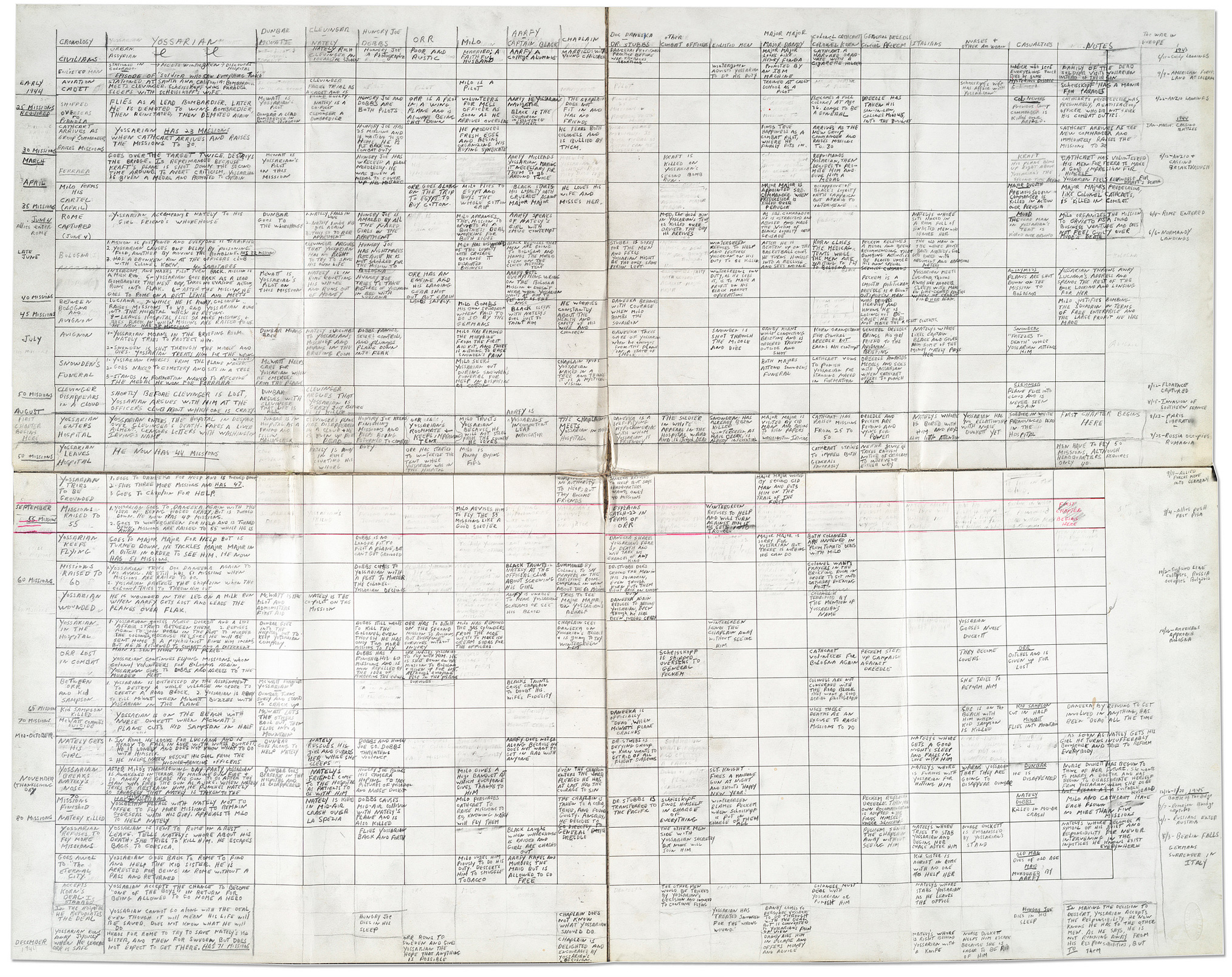
On the website Open Culture there is a discussion by Colin Marshall of the outline used by Joseph Heller when he wrote his comic novel Catch-22. This implicates Evelyn Waugh’s dismissive attitude toward the book (Letters, pp. 571-72) :

When Catch-22 finally went into print, one of its advocates, an advertising manager named Nina Bourne, launched an aggressive one-woman campaign to get copies into the hands of all the influential readers of the day. “You are mistaken in calling it a novel,” replied Evelyn Waugh. “It is a collection of sketches — often repetitious — totally without structure.” But the book’s apparently free-form narrative, full of and often turning on puns and seemingly far-fetched associations, had actually come as the product of a deceptive compositional rigor. As one piece of evidence we have Heller’s handwritten outline above. (You can also find a more easily legible version here.)

An article on the London-based website The Conservative Woman considers an issue raised in Brideshead Revisited. The author, journalist Fionn Shiner, was “most interested in the figure of Lord Marchmain, the father of the Flytes, whose inexplicable hatred of their mother, and his adulterous ways, are a catalyst for the family’s tragic lives.” She goes on to discuss a Swiss study of the impact of this phenomenon within families. The website invites comments of which a considerable number seem to have been filed.

On the website Literary Hub, Emily Temple made a survey of the favorite books lists of famous authors to see what books were most popular among this rarified group. She explains her methodology:

I looked at 68 lists made by famous authors, from the classic …  to the contemporary …, and kept track of which books they recommended most often. The results were interesting—not particularly because of the most recommended books (many of them are pretty predictable) but because of the details—the groupings, the exclusions, the agreements between authors you wouldn’t necessarily think had similar taste.

Waugh’s novel A Handful of Dust was among the most listed books, appearing on the lists of Tom Stoppard, Jay McInerney, Danzy Senna. He was also among the writers with multiple book mentions: A Handful of Dust (as above); Brideshead Revisited (Stephen King); Put Out More Flags (Alan Hollinghurst).

Finally, Roman Catholic literary journalist and critic Joseph Pearce has responded to requests by his readers that he publish his own Desert Island selections of books. He offers a list that is, not surprisingly, heavy with Catholic writers such as G K Chesterton and Hilaire Belloc. Waugh has a book included in his 10 selected novels: “Brideshead Revisited by Evelyn Waugh could not possibly be left behind.” The entire list that includes 10 each in poems, plays, nonfiction and great ideas is available on the National Catholic Register’s website.

Share
Posted in A Handful of Dust, Brideshead Revisited, Decline and Fall, Newspapers, Put Out More Flags, Rossetti: His Life and Works, Vile Bodies | Tagged , , , , , , , | Comments Off on Early Summer Roundup: Promotions and Lists

90th Anniversary of Waugh’s First Marriage

Evelyn Waugh married Evelyn Gardner on 27 June 1928 at St Paul’s Church, Portman Square, London. Only a few friends of the bride and groom were present, including Alec Waugh and Pansy Pakenham (witnesses), Robert Byron and Harold Acton (best man). The marriage was short-lived and ended in divorce  in 1930.

Share
Posted in Alec Waugh, Anniversaries, Evelyn Waugh | Tagged | Comments Off on 90th Anniversary of Waugh’s First Marriage

Abingdon Arms Announces Waugh Plaque Unveiling

The Abingdon Arms in Beckley, Oxon., has announced the details of its plans for the unveiling of a plaque commemorating the association of Evelyn Waugh with their premises. See previous posts. Here is the message from the organizer of the event:

Evelyn Waugh’s grandson Alexander will be the guest of honour at the unveiling of a blue plaque to the writer at the Abingdon Arms pub, Beckley, on Saturday July 28th from 6pm. Waugh regularly stayed with Alastair Graham in a caravan at the pub while a student, and later honeymooned there with his first wife. It was while working there on Vile Bodies that he received a letter from her telling him she had fallen in love with a mutual friend.

The plaque will say: ‘Evelyn Waugh, Author, wrote, drank and loved here 1924-1931.’ The unveiling will be held on a significant date for Waugh. On July 28th 1924 his diary records him being invited to ‘a big feast’ in the barn next to the pub, at which “until about 3 in the morning the whole village sat and ate and drank and danced and sang.” Early next morning, Waugh cycled into Oxford to attend his viva, at which he learned of his “certain third.” The following day he “rode back to Beckley where we drank champagne… it was another very drunken night at the Abingdon Arms.”

Accordingly, the unveiling will be followed by a ‘big feast’ at which diners will enjoy a four-course menu, specially created by the Abingdon Arms’ acclaimed chef Joe Walton, based on dishes that Waugh records having eaten during his time at Beckley, including peaches soaked in burgundy and ale-braised beef with celery. The event culminates an extraordinary twelve months for the community-owned Abingdon Arms, which in June was named ‘Community Pub of the Year’ by Sawdays. Tickets for the Big Feast are available from The Abingdon Arms (+44) 1865 655667 (click to email) priced at £43 including canapes. The unveiling will be from 6pm; the feast follows at 7 for 7.30pm.

The pub is just over 7 miles northeast of Oxford station. Public transport information is not available from Google but a local transport site recommends a taxi.

Share
Posted in Alexander Waugh, Evelyn Waugh, Events, Oxford, Vile Bodies | Tagged , | Comments Off on Abingdon Arms Announces Waugh Plaque Unveiling

New Swedish Brideshead

A review by Johan Norberg of a new translation of Brideshead Revisited into Swedish appears in the Stockholm newspaper Expressen. The translation is by Hans-Jakob Nilsson and the title is En förlorad värld–åter till Brideshead (“A Lost World: Return to Brideshead”). It was first published by Wahlström & Widstrand in 2015. See previous post.  A Swedish version was originally published in 1946 without the “Brideshead” subtitle. That translation was apparently by Margaretha Odelberg and a new edition was published at least once in 1982 (apparently in connection with the 1981 TV series).

The review starts with a reference to the TV series, which was called in Swedish Gensyn med Brideshead (closer to the original English version) and then describes the latest edition as a:

…new, elegant yet available Swedish translation by Hans-Jacob Nilsson , in a refined emerald-green volume that could have been on Sebastian Flyte’s table in Christ Church, Oxford, the first time a nervous and expectant Charles comes there for lunch …

The novel can be read on so many levels. There are intoxicating nostalgic youth depictions, sacrificing social satire and religious reasoning, while also dealing with the architecture and interior design of the country estate. You can never get depressed by any party before the next one comes.

The Catholic Waugh said that this was a novel about divine grace and many others that it is a novel about class. Both of them are correct. It is a swan song for the aristocracy that Waugh admired, but it is hardly the one we long for. It is a defense of faith, but as  Johanna Kolion observes in the afterword, it is strange for a religious novel to produce secular life that is so surprising [överlägset lockande ?]…

A friend of mine usually claims that “Brideshead” should be two separate novels. One that only deals with Charles and Sebastian and endless summers. Because we would love to remain in this happy childhood, which seems so innocent, even though its loadability [lastbarhet ?] has a place high in the catalog of difficult sins. Another novel would be about Sebastian’s complicated and suffocating family, about his alcoholism, about war, religion and grace. But in fact, of course, it is the combination of these two stories that makes the novel so strong and painful.

The review concludes:

…The first chapter is called “Et in Arcadia ego” so there is no doubt that this is a dance on the verge of the abyss. The Swedish title, which has existed since 1946, is equally clear: “A lost world”. Evelyn Waugh also wrote it during World War II, when uniforms, rationing and lost limbs gave him a longing for a fiery epoch’s gratitude and easy-going decadence. With full stomach he later found many of the descriptions repulsive. But we, who never experienced it from the beginning, will not be measured so easily. Charles goes to that first lunch with Sebastian because he hopes he will find the low door in the wall leading to a secret and enchanted garden in the heart of the gray city. For many of us readers, the door is  called “Brideshead revisited”.

The translation of the review is by Google with some edits. Any suggestions on the translation are welcome by commenting as provided below.

Share
Posted in Brideshead Revisited, Evelyn Waugh, Newspapers | Tagged , , , | Comments Off on New Swedish Brideshead

BBC Airs Muriel Spark Film

BBC2 last week broadcast a one hour documentary on the life and works of novelist Muriel Spark: The Many Primes of Muriel Spark. This was originally transmitted in January on BBC Scotland to mark Spark’s centenary. The program was presented by Kristy Wark and filmed, produced and directed by Morag Tinto for BBC Studios: Pacific Quay Productions. The film was mostly interviews of living writers who shared their views of Spark’s work along with numerous clips from BBC interviews of Spark herself dating back to a 1961 b&w program about the Brontës. These were interspersed with appearances and commentary by Wark as described in the BBC program notes:

Kirsty retraces Muriel’s footsteps from the cobbled streets of Edinburgh to the sublime beauty of Victoria Falls. Contributions from writers AL Kennedy, Janice Galloway, Ali Smith, William Boyd and Val McDermid tell of Muriel Spark’s unique literary style and a life full of reinvention.

Kirsty meets with the journalist Alan Taylor, who has recently published his memoir of Muriel, and she travels to Italy for the first television interview with Penelope Jardine, Muriel’s close friend of 40 years

Although the program discusses the relatively late beginning of Spark’s career as a writer and her conversion to Roman Catholicism, it does not mention her early support by Evelyn Waugh and Graham Greene. There is also a fairly extended description of Spark’s mental breakdown just before her first novel The Comforters (1957) was written and her own description of it and how she wrote about it; but there is no mention of similarities with Waugh’s nearly contemporaneous breakdown and its description in his novel The Ordeal of Gilbert Pinfold (1957). More surprising is the failure to mention or interview Waugh’s biographer Martin Stannard who spent several (sometimes frustrating) years writing Spark’s official biography which was published in 2009 after her death in 2006.

Aside from these omissions, the program is very well done. The editing is excellent, and it moves chronologically through Spark’s rather complicated early life, concluding in Italy where Penelope Jardine is interviewed. The program is available to stream on BBC iPlayer for 25 days. A UK internet connection is required.

Share
Posted in Biographies, Documentaries, Interviews, Television Programs, The Ordeal of Gilbert Pinfold | Tagged , , | Comments Off on BBC Airs Muriel Spark Film

Waugh Short Stories in German Translation

A collection of 15 Waugh short stories has been published in German as Ausflug ins wirkliche Leben (Trip to Real Life). The book, reviewed by Diana Wieser, is a recent paperback reprint of the 2013 edition, both published by Diogenes Verlag in Zurich. There are several translators credited. The review appears on a website called SL Leselust. Here are some translated excerpts:

Often copied, never bested: English eccentricity – who does not love him? Author Evelyn Waugh is the uncrowned master of this supreme discipline. No one else knows how to pack nasty intrigues, great attitudes and the strange pairings of the English upperclass in such unerring punchlines. Waugh is a brilliant observer. …

Between tea dance and tennis tournament the world is not in order. The British upperclass has its own problems in the 20s to 50s. In the elite boarding school, peers test themselves in power games, on an East African colonial island, seven bachelors compete for the daughter of an oil magnate, the only unmarried white man far and wide. A cuckholded husband is looking for the big adventure in the Amazon…Waugh finds a big favor in lunatics of all kinds, be it in the sanatorium or in the film business, be it war-traumatized ex-soldiers or megalomaniac lap-dogs. Many stories have a serious background, for example through the theme of the two world wars. This presents Waugh wrapped in a “clotted cream” of irony, acumen and linguistic skill. Behind the force of humor are subtle messages. Not infrequently, the conclusion remains open or ambiguous. The beginning is invariably brilliant…

As can be seen from the examples, interpersonal relationships and their inherent tragedy form an essential theme in the prose of the author. There are many women who are smarter, cunning, and more sexually active than their husbands. …. His first marriage to Evelyn (!) Gardner ended due to the many flings of his wife, who had already been engaged nine times before their marriage and in the 20s shared a flat with a girlfriend founded. At that time a scandal that even landed in the press.But what sets Waugh’s great class apart is that he does not take a bitter perspective on relationship histories by attributing victimhood. …

Evelyn Waugh is more relevant than ever. His stories have lost nothing of humor and sophistication. On the contrary, reading them today is even more fun! Simply because they are sometimes politically incorrect–in a witty, nonchalant way. Who else could report on a future with euthanasia tourism, if not Waugh? Whether homosexuality, the loss of virginity or meek serial killer – as usual black-humored Evelyn Waugh ventures on every subject. It is not for nothing that TC Boyle, one of the modern grandmasters of bitter bad tops, calls him a role model.

Conclusion: Buy! Read! Have a good time!

The translation of the review is by Google with minor edits.

Share
Posted in Collections, Evelyn Waugh, Short Stories | Tagged , , | Comments Off on Waugh Short Stories in German Translation

A Visit to Burgh House Exhibit: Evelyn Waugh and Basil Bourchier

Milena Borden has kindly sent this report of her visit to a Waugh-related exhibit in North London which was mentioned in a previous post:

Closing this Sunday, the exhibition A Totally Preposterous Parson: Evelyn Waugh and Basil Bourchier is displayed in the very small and narrow hallway connecting other rooms on the second floor of the charming Burgh House, situated on a pretty, leafy corner of Hampstead just over a mile from Evelyn Waugh’s family home on 145 North End Road. There are two large portraits of the Reverend Basil Graham Bourchier hanging on each of the side walls alongside a smaller one of Dame Henrietta Barnett.  

The Evelyn Waugh display is in a glass cabinet under one of the portraits. It  consists of two books and a document: a copy of the first edition of A Little Learning (1964) showing the front cover and another one opened on pp. 132-33 pointing to paragraphs describing Rev. Bourchier of  the church “St Jude” in Hampstead Garden Suburb as “a totally preposterous parson”. Next to these is a bound volume with “St Jude’s Parish Paper, 7 July 1916” where the confirmation of Arthur Evelyn St. John Waugh on St. Peter’s Day, 29 June 1916 is recorded. There is also an A4 page with written information by the curator Reverend Alan Walker describing the relationship between Waugh and the vicar and concluding that, despite the ridicule, it was Bourchier who introduced Waugh to religion: “As a schoolboy [Waugh] was clearly amused by Bourchier’s idiosyncratic presentation of Anglo-Catholicism, but he does not seem to have doubted its essential truth, indeed for all Bourchier’s ‘extravagant displays’, it was at St Jude’s,” explains Walker, that Waugh first “had some glimpse of higher mysteries.” Walker has also written a book about the subject of the exhibit (109 pages) which is for sale at the price of £10 in the shop downstairs.

The history of Waugh’s relationship to the Church of England, his early childhood years in Hampstead and his introduction to the liberal theology preached by Bourchier is displayed very nicely here. Except it is, perhaps unintentionally, misleading. Waugh converted to Roman Catholicism in 1930 and connected his life to what he viewed to be the true religion of his country. Thus he drew a line between his family upbringing in the Church of England and for the rest of his life remained loyal to the Roman Catholic Church. It was hard not to think that using his name liberally to advertise local history and also to enhance the recently adopted business plan of the Burgh House to attract visitors and wedding planners, would have only reinforced Waugh’s dislike of modernism. 


Share
Posted in A Little Learning, Catholicism, Evelyn Waugh, Events, Hampstead, Waugh Family | Tagged , , | Comments Off on A Visit to Burgh House Exhibit: Evelyn Waugh and Basil Bourchier

Roundup: Ruins, Snobs and Remittance Men

An art exhibit in Sheffield is named for a Waugh story. This is Love Among the Ruins at the S1 Artspace gallery. The gallery is temporarily located in the garage of the Park Hill housing estate while another part of the estate is being converted into a cultural center. Park Hill dates from 1961 when it was built in brutalist concrete style (now Grade II listed) along with a neighboring estate called Hyde Park which is already largely demolished. They were part of a social housing scheme which has since been abandoned. The exhibit displays photographs by two photographers retelling the story of life in the two estates when they were still used for housing. A explained in a local paper The Star, the exhibition:

… runs from July 20 to September 15, taking its full title from a satirical short story by Evelyn Waugh, which imagined a dystopian Britain of the future governed by an overbearing welfare state. Written in 1953, Waugh’s story anticipated some of the concerns about the possible social consequences of the government’s post-war approach to rebuilding the country.

Waugh’s story is also published in his Complete Stories volume.

The German-language newspaper Volksstimme, published in Basel, Switzerland, has an article entitled “Ein engischer snob in Africa”. This is by Simone Pfaff and relates to Waugh’s travel book Remote People, translated into German as Expeditionen eines englischer Gentleman. The text of the article is behind a paywall, but a summary is provided: “The book is a timeless account of being on the move as in a nightmare – and as such is a jewel of travel writing.” Translation by Google. 

In a Durban, South Africa paper, The Mercury, there is an article about English “remittance men”. These were usually second sons who disgraced themselves in England and were sent out to Africa where they received a monthly remittance from their families on the understanding that they would stay there. Among the most famous are Denys Finch Hatton, immortalized in Isak Dinesen’s novel and the Hollywood film Out of Africa, William Henry Drummond and Charles Hamilton. Also receiving a mention is a second son in Evelyn Waugh’s novel Brideshead Revisited who “develops an incurable drinking problem and ends up in Morocco as a remittance man.” This is Sebastian Flyte.

In a post on his website, blogger “Professor Mondo” reports from a visit to a comics convention in Charlotte, NC:

So as we headed to the con Friday afternoon, I saw a sign for a local business, but since we were at speed and I was staying alert to the traffic, all I caught were the words “Pet Crematory” in an elegant serif typeface. And that was less than cheering, I guess, but a sad necessity of life, particularly in urban areas where you might not have a yard suitable for burying a dead pet (or a live one, for that matter, not that I recommend that.)

But on the way back to the hotel, I saw the sign again, and this time I caught the business’s name: “Paws, Whiskers, and Wags.” And maybe it’s just me, but I felt like I had just discovered a near-perfect intersection of sweet and creepy, a sort of Uncanny Valley of euphemism where the sentimentality turns rancid somehow.

I mean, I suppose it’s better than “Fry-do’s” or “Fleas-y Bake Ovens” for an enterprise of its type, and as I said, I know the business meets a real need. Still, I found myself wondering if Dennis Barlow was in the neighborhood, or whether someone was taking a dip at Norma Desmond’s mansion.

Finally, on the Hertford College website, one of its alumni reports how Evelyn Waugh helped him get into Oxford. This is Eric Martin (Medicine, 1961) who went on to practice radiology in the USA. He explains that when his application to Merton College was turned down, he was invited to apply to Hertford, with this happy result:

I got a charming letter from the late Miles Vaughan Williams offering me a place at Hertford. One of my essays had been on Brideshead Revisited. After a couple of paragraphs I discovered I couldn’t remember Charles Ryder’s name, but it was too late to pick another topic so I soldiered on, hoping against hope that he would emerge from my sleep deprived fog. Perhaps I got points for ingenuity, but Miles opened his letter by saying “did I know that Evelyn Waugh was a Hertford man?”


Share
Posted in Brideshead Revisited, Evelyn Waugh, Love Among The Ruins, Newspapers, Oxford, Remote People, The Loved One | Tagged , , , , | Comments Off on Roundup: Ruins, Snobs and Remittance Men