Major Study of Waugh’s War Trilogy Published

Two well-known Waugh scholars have collaborated on a detailed study of Waugh’s War Trilogy. Their long-awaited work, In the Picture: The Facts Behind the Fiction in Evelyn Waugh’s “Sword of Honor,” was recently published by Editions Rodopi B.V. (Amsterdam and New York, 360 pp., U.S. $98.73, U.K. £70.20). It consists of two parts. The first by Carlos Villar Flor relates the actual historical facts to the events described in Waugh’s trilogy. The second by Donat Gallagher places into context earlier and controversial interpretations of Waugh’s war career from writers such as Christopher Sykes, Antony Beevor, Lord Lovat and Waugh himself  by comparing them to more objective and complete accounts in other archival materials now available.

Share
Posted in Academia, Books about Evelyn Waugh, Men at Arms, Miscellaneous, Officers and Gentlemen, Sword of Honour, Unconditional Surrender/The End of the Battle, World War II | Tagged , | 1 Comment

Sword of Honour Among Telegraph’s Best War and History Books

Waugh’s Sword of Honour Trilogy was listed by the Daily Telegraph earlier this year among “Best War and History Books of All Time.” The list consisted of 35 books, including both fiction and history in English and translation. Here is the entry for Sword of Honour:

Loosely autobiographical, this three-part meandering, tragic-comic farce paints a convincingly chaotic picture of the British muddling their way to winning the war. It is beautifully world weary and cynical, as the hapless hero is buffeted by the forces of class, waste, spite, cowardice and inefficiency.

The Telegraph offers no criteria for how or by whom selections were made. Other listed WWII novels written in English include Joseph Heller’s Catch-22 (which Waugh dismissed–Letters, 571–as indelicate, prolix, repetitious and totally without structure, although he found much of the dialogue to be funny), Kurt Vonnegut’s Slaughterhouse-5, Norman Mailer’s The Naked and the Dead, and Louis de Bernieres’ Captain Corelli’s Mandolin. Also listed is the translated novel Legion of the Damned by the enigmatic Danish writer Sven Hassel. The list was first published on May 4, 2014 and now appears on the Telegraph’s website under a “Books to Read” collection.


Share
Posted in Miscellaneous, Sword of Honour, World War II | Tagged , , | Comments Off on Sword of Honour Among Telegraph’s Best War and History Books

Waugh Identified as Character Model in Daughter-in-Law’s Thriller

Ephraim Hardcastle, a gossip columnist for the Daily Mail, has identified Evelyn Waugh as a possible model for the villain in his daughter-in-law’s new thriller. Hardcastle writes in the paper’s 25 November edition about the latest novel (A Long Hot Unholy Summer) of Lady Teresa Waugh, widow of  Auberon Waugh, in which there is

a male villain with ‘a troubled past and twisted sexual nature’… Some will suspect the character is modelled on Evelyn Waugh, who had a troubled past and complicated sexual history.

The novel will not be published until next Monday, 1 December.

Hardcastle’s connection between the “male villain” and Evelyn Waugh apparently was made without the benefit of his having read any more than the publisher’s blurb, from which he quotes. It seems unlikely that there could be any reasonably justifiable connection to be made to a character who, so far as appears from that blurb, may be suspected as an online sexual predator of young girls–hardly the sort of “complicated sexual history” one would associate with Evelyn Waugh. If there were a basis for Waugh as a character model in another writer’s novel, that would not be his first such appearance. There are characters in novels by Henry Williamson (Anthony Cruft in The Power of the Dead) and Ferdinand Mount (a WWII book-writing Army officer called “Wigg or Wogg,” in The Man Who Rode Ampersand) that are obvious ringers for Waugh.

Share
Posted in Auberon Waugh, Miscellaneous | Tagged , , | Comments Off on Waugh Identified as Character Model in Daughter-in-Law’s Thriller

Waugh Cameo in BBC Series on Tatler Magazine

BBC has started a series of three programs on Tatler magazine: Posh People: Inside Tatler. In the first episode (Monday, 24 November) Matthew Bell, newly appointed Commissioning Editor, is among those interviewed. He was formerly the society diarist for the Independent on Sunday newspaper but describes himself as from a solidly middle class family. The editor, Kate Reardon, explains that the magazine is as interested in the well-behaved newly rich as it is in the debauched aristocracy.  In pursuit of the latter, Bell is dispatched to Oxford to investigate the Bullingdon Club, and specifically to find out how they have managed to suppress the club photograph that included David Cameron in his days as a member. Bell is filmed outside Hertford College (40:27), which he explains was where Evelyn Waugh lived as an undergraduate. He cites Waugh as having satirized the Bullingdon in Decline & Fall where he described it as “the sound of English county families baying for broken glass.” He might have mentioned that Waugh renamed it the Bollinger. Bell attributes his own interest in the upper class life to his having read Waugh’s novels from the age of 12. As depicted by Waugh, the upper classes appealed to Bell as seeming to have “such a fun time, in a romantic world.” The series continues on BBC 2 next Monday and can be viewed on the internet via BBC iPlayer for the next four weeks. A proxy server connection is needed from outside the UK.

Share
Posted in Decline and Fall, Documentaries, Miscellaneous, Oxford, Television Programs | Tagged , , , , | 1 Comment

Guardian Adds Scoop to Top 100 Novels List

Robert McCrum, novelist and literary journalist, has for several months been writing a weekly Guardian column naming and discussing what he considers the 100 best novels in English. He is working through the history of English novel year by year from the “beginning” (Pilgrim’s Progress) to the present day (although some years are skipped over and others have multiple selections). He has now arrived at the 1930s. His latest selection, no. 60 on the list, is Waugh’s Scoop, which was also recently named by the Daily Telegraph in an anonymous top 100 list. McCrum’s columns usually stir up a lively discussion among Guardian readers, and this one is no exception, with expressions of supporting and contrary views of the book selected. There are several votes for Handful of Dust among this week’s commenters. Most of McCrum’s own commentary addresses the journalistic targets of Waugh’s satire. This is not surprising, given McCrum’s career as a literary journalist. I feared that he might miss out my own favorite parts of the book, which are those that take place at Boot Magna. But I was gratified when I reached his conclusion:

Many of these caricatures might remind some readers of Waugh’s debt to Dickens, but Scoop remains fiercely modern. So little has really changed. The six words of “Up to a point, Lord Copper” conjure a marrow-freezing universe of corporate fear. Most famous of all, there’s the glorious parody of the “feather-footed” vole questing through the “plashy fen”, a pointed reminder of the deep sentimentality always to be found in the Street of Shame.


Share
Posted in A Handful of Dust, Miscellaneous, Scoop | Tagged , , | Comments Off on Guardian Adds Scoop to Top 100 Novels List

Lecture by Dr. Lisa Colletta at the American University of Rome, “Travelers, Exile, and Expats: British Novelists in Hollywood”

On November 13 at 7:00 p.m., at the American University of Rome, Dr. Lisa Colletta will give her inaugural lecture as a full professor at AUR. Based upon her 2013 book exploring the same subject, her lecture “Travelers, Exile, and Expats: British Novelists in Hollywood” is teased as follows on the AUR website:

Was early Hollywood, with its celluloid dreams and theme-park cemeteries, the beginning of the end of the Western humanist tradition? Drawn to Los Angeles for a variety of reasons that included everything from easy money, political disaffection, spiritual longing, and the Mediterranean climate, writers such as Aldous Huxley, Christopher Isherwood, Anthony Powell, J.B Priestly, Dodie Smith and Evelyn Waugh, and P.G. Wodehouse represent an incursion of expert settlers representing British culture and civilization. But instead of establishing themselves once again with a mission of colonial superiority, they soon found that their cultural power clashed with the commercially inviolable mass production of American popular culture. Lisa Colletta explores how the British experience in Southern California challenged traditional ideas of national identity and power and implicated them in a complex of choices and influences filtered through the Hollywood dream machine.

Share
Posted in Academia, Events, Lectures, The Loved One | Tagged , , | Comments Off on Lecture by Dr. Lisa Colletta at the American University of Rome, “Travelers, Exile, and Expats: British Novelists in Hollywood”

Editor of Waugh’s Letters Retires from The Spectator

Mark Amory, who edited the pioneering volume of Evelyn Waugh’s letters that appeared in 1980, has recently announced his retirement as Literary Editor of The Spectator. He went to work there in “about 1985.” In his valedictory article announcing his departure, he recalls that in his early days he would arrive at his office only to find no one on the premises sufficiently sober to compose a magazine, but was impressed that it still managed to appear each week.

A similar situation seems to have prevailed at Amory’s retirement party, also held in The Spectator’s offices. This event was reported by Jeremy Clarke (author of the magazine’s “Low Life” column) in this week’s edition. Clarke arrived late, well primed by a few pints in the pub across the street, and worked his way drink-by-drink to the back of the room where Amory sat at a table with his two daughters. On his way, Clarke recalled earlier meetings with Amory:

At a Spectator party in Doughty Street I’d sought him out and said, ‘Was it really you who edited Evelyn Waugh’s letters?’ He said that it was. Had he met him? He had. He was friends with Auberon as a schoolboy, and he used to stay at Combe Florey in the holidays. I was inarticulate, he said, only managing the most common expletive by way of a reply.  And at virtually every summer party since then, I’ve lurched or bounded up to him and said, ‘Go on, then. What was He like?’…Being a perfectly polite man, every year Mark Amory pretends to consider my inane question afresh, and every year he had said, as though suddenly struck by a very new aspect of the man, ‘He wanted you to please him; and he made you want to please him.’

Unfortunately, on this occasion Amory spotted Clarke as he lurched toward the table and made “a dash for it… shepherding his girls ahead of him, saying that he was leaving for Ireland.” Clarke concludes with a description of own journey into ever increasing stages of inebriation at other nearby venues as the caterers cleared up after Amory’s last Spectator party

Share
Posted in Letters | Tagged , , | Comments Off on Editor of Waugh’s Letters Retires from The Spectator

Complete Works Event at Literary Leicester Festival, Nov. 12

From the Arts & Humanities Research Council’s news pages:

It’s been just over a year since work began on the first ever Complete Works of Evelyn Waugh. Together with Oxford University Press and the Waugh family, the project has been working to make not only Waugh’s novels available to the public but also his biographies, short stories, letters and diaries, and all his essays, articles and reviews spanning half a century of writing life.

At this event [at this year’s Literary Leicester festival], join Waugh biographer and co-executive editor Martin Stannard, research associate Barbara Cooke and doctoral student Rebecca Moore as they look back over 12 months of reading, editing and – occasionally – discovering new Waugh materials. Martin will introduce the project in general and his work on ‘Vile Bodies’ in particular (Waugh was in the middle of writing it when his first wife left him). Barbara will be talking about working with the thousands of letters and diary extracts which should be included in the edition, while Rebecca will report back on her research into the concept of decadence in Waugh.

For further information, please contact Barbara Cooke: (click to email).

Share
Posted in Complete Works, Events, Festivals, Research, Vile Bodies | Tagged , , , , | Comments Off on Complete Works Event at Literary Leicester Festival, Nov. 12

Previously Unknown Evelyn Waugh Letters for Sale at Bonhams

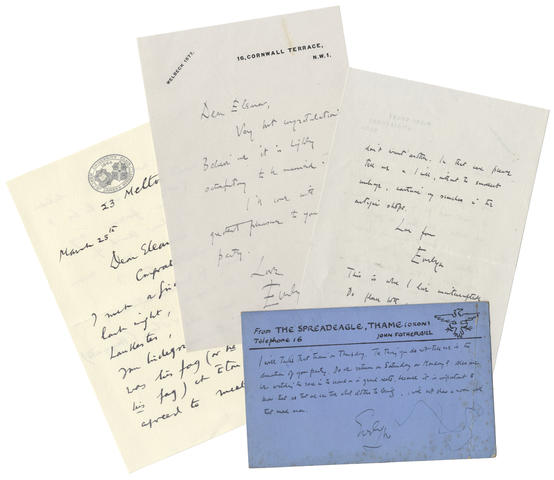
Three previously unknown letters from Evelyn Waugh to his friend Eleanor Watts, the girlfriend of the man who ran off with the novelist’s wife in 1929, are to be sold at Bonhams Fine Books, Atlases, Manuscripts and Photographs Sale on 12 November in London.

More at Fine Books & Collections magazine.

Share
Posted in Auctions, Brideshead Revisited, Letters, Vile Bodies | Tagged , | Comments Off on Previously Unknown Evelyn Waugh Letters for Sale at Bonhams

New Age Waugh

This week’s New York Times Book Review contains a review by writer David Leavitt of a novel by British satirist Edward St. Aubyn that was originally published in England in 1998. The novel, entitled On the Edge, is compared to Waugh’s The Loved One and William Boyd’s Stars and Bars in that it “indulges some very British lampooning of American culture and its excesses.” An example quoted by Leavitt of St. Aubyn’s targets is the U.S. food industry:

Menus couldn’t decide whether to advertise dieting or eating.  Often the contents of salads and sandwiches hung around shyly among the real stars: the ingredients that had been left out, and the pointless variety of methods by which the sodium-free, unbleached, sugarless, decaffeinated, coffee-free coffee could be vaporized, sun-dried, skimmed, scorched and served in 16 different kinds of cup.

The book’s belated U.S. publication is attributed to the success in this country of St. Aubyn’s Patrick Melrose series of five linked novels. Leavitt thinks it may have been passed over initially by U.S. publishers for fear of a backlash because of its sharp satirization of the U.S.  But that did not happen in the case of The Loved One nor for that matter in the case of the Melrose novels where features of U.S. culture were subject to equally pointed satirical attacks. In this case, St. Aubyn has done for the New Age spa (think Esalen Institute) what Waugh did for the U.S. funeral industry (think Forest Lawn). Both institutions have survived satirization and have continued to flourish.

In another allusion to Waugh, Leavitt notes the novel’s  “complexity and subtlety, as well as the the elegance with which it modulates between Waughian parody and Fosterian pathos.” Waugh fans could do worse than to try St. Aubyn if they are looking for Waugh’s satirical spirit applied to updated targets, both in the U.S. and elsewhere. Indeed, St. Aubyn, like Waugh, is no shrinking violet when he aims his pen at the foibles of his own countrymen, with particular reference to its upper classes.

Share
Posted in Miscellaneous, Sightings, The Loved One | Tagged , , , , , , , | Comments Off on New Age Waugh