Lecture by Dr. Lisa Colletta at the American University of Rome, “Travelers, Exile, and Expats: British Novelists in Hollywood”

On November 13 at 7:00 p.m., at the American University of Rome, Dr. Lisa Colletta will give her inaugural lecture as a full professor at AUR. Based upon her 2013 book exploring the same subject, her lecture “Travelers, Exile, and Expats: British Novelists in Hollywood” is teased as follows on the AUR website:

Was early Hollywood, with its celluloid dreams and theme-park cemeteries, the beginning of the end of the Western humanist tradition? Drawn to Los Angeles for a variety of reasons that included everything from easy money, political disaffection, spiritual longing, and the Mediterranean climate, writers such as Aldous Huxley, Christopher Isherwood, Anthony Powell, J.B Priestly, Dodie Smith and Evelyn Waugh, and P.G. Wodehouse represent an incursion of expert settlers representing British culture and civilization. But instead of establishing themselves once again with a mission of colonial superiority, they soon found that their cultural power clashed with the commercially inviolable mass production of American popular culture. Lisa Colletta explores how the British experience in Southern California challenged traditional ideas of national identity and power and implicated them in a complex of choices and influences filtered through the Hollywood dream machine.

Share
Posted in Academia, Events, Lectures, The Loved One | Tagged , , | Comments Off on Lecture by Dr. Lisa Colletta at the American University of Rome, “Travelers, Exile, and Expats: British Novelists in Hollywood”

Editor of Waugh’s Letters Retires from The Spectator

Mark Amory, who edited the pioneering volume of Evelyn Waugh’s letters that appeared in 1980, has recently announced his retirement as Literary Editor of The Spectator. He went to work there in “about 1985.” In his valedictory article announcing his departure, he recalls that in his early days he would arrive at his office only to find no one on the premises sufficiently sober to compose a magazine, but was impressed that it still managed to appear each week.

A similar situation seems to have prevailed at Amory’s retirement party, also held in The Spectator’s offices. This event was reported by Jeremy Clarke (author of the magazine’s “Low Life” column) in this week’s edition. Clarke arrived late, well primed by a few pints in the pub across the street, and worked his way drink-by-drink to the back of the room where Amory sat at a table with his two daughters. On his way, Clarke recalled earlier meetings with Amory:

At a Spectator party in Doughty Street I’d sought him out and said, ‘Was it really you who edited Evelyn Waugh’s letters?’ He said that it was. Had he met him? He had. He was friends with Auberon as a schoolboy, and he used to stay at Combe Florey in the holidays. I was inarticulate, he said, only managing the most common expletive by way of a reply.  And at virtually every summer party since then, I’ve lurched or bounded up to him and said, ‘Go on, then. What was He like?’…Being a perfectly polite man, every year Mark Amory pretends to consider my inane question afresh, and every year he had said, as though suddenly struck by a very new aspect of the man, ‘He wanted you to please him; and he made you want to please him.’

Unfortunately, on this occasion Amory spotted Clarke as he lurched toward the table and made “a dash for it… shepherding his girls ahead of him, saying that he was leaving for Ireland.” Clarke concludes with a description of own journey into ever increasing stages of inebriation at other nearby venues as the caterers cleared up after Amory’s last Spectator party

Share
Posted in Letters | Tagged , , | Comments Off on Editor of Waugh’s Letters Retires from The Spectator

Complete Works Event at Literary Leicester Festival, Nov. 12

From the Arts & Humanities Research Council’s news pages:

It’s been just over a year since work began on the first ever Complete Works of Evelyn Waugh. Together with Oxford University Press and the Waugh family, the project has been working to make not only Waugh’s novels available to the public but also his biographies, short stories, letters and diaries, and all his essays, articles and reviews spanning half a century of writing life.

At this event [at this year’s Literary Leicester festival], join Waugh biographer and co-executive editor Martin Stannard, research associate Barbara Cooke and doctoral student Rebecca Moore as they look back over 12 months of reading, editing and – occasionally – discovering new Waugh materials. Martin will introduce the project in general and his work on ‘Vile Bodies’ in particular (Waugh was in the middle of writing it when his first wife left him). Barbara will be talking about working with the thousands of letters and diary extracts which should be included in the edition, while Rebecca will report back on her research into the concept of decadence in Waugh.

For further information, please contact Barbara Cooke: (click to email).

Share
Posted in Complete Works, Events, Festivals, Research, Vile Bodies | Tagged , , , , | Comments Off on Complete Works Event at Literary Leicester Festival, Nov. 12

Previously Unknown Evelyn Waugh Letters for Sale at Bonhams

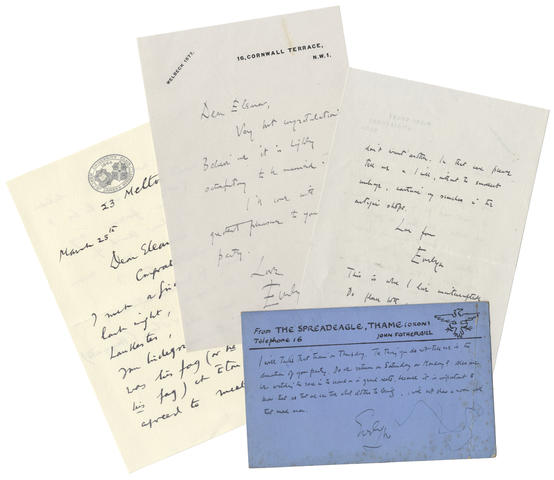
Three previously unknown letters from Evelyn Waugh to his friend Eleanor Watts, the girlfriend of the man who ran off with the novelist’s wife in 1929, are to be sold at Bonhams Fine Books, Atlases, Manuscripts and Photographs Sale on 12 November in London.

More at Fine Books & Collections magazine.

Share
Posted in Auctions, Brideshead Revisited, Letters, Vile Bodies | Tagged , | Comments Off on Previously Unknown Evelyn Waugh Letters for Sale at Bonhams

New Age Waugh

This week’s New York Times Book Review contains a review by writer David Leavitt of a novel by British satirist Edward St. Aubyn that was originally published in England in 1998. The novel, entitled On the Edge, is compared to Waugh’s The Loved One and William Boyd’s Stars and Bars in that it “indulges some very British lampooning of American culture and its excesses.” An example quoted by Leavitt of St. Aubyn’s targets is the U.S. food industry:

Menus couldn’t decide whether to advertise dieting or eating.  Often the contents of salads and sandwiches hung around shyly among the real stars: the ingredients that had been left out, and the pointless variety of methods by which the sodium-free, unbleached, sugarless, decaffeinated, coffee-free coffee could be vaporized, sun-dried, skimmed, scorched and served in 16 different kinds of cup.

The book’s belated U.S. publication is attributed to the success in this country of St. Aubyn’s Patrick Melrose series of five linked novels. Leavitt thinks it may have been passed over initially by U.S. publishers for fear of a backlash because of its sharp satirization of the U.S.  But that did not happen in the case of The Loved One nor for that matter in the case of the Melrose novels where features of U.S. culture were subject to equally pointed satirical attacks. In this case, St. Aubyn has done for the New Age spa (think Esalen Institute) what Waugh did for the U.S. funeral industry (think Forest Lawn). Both institutions have survived satirization and have continued to flourish.

In another allusion to Waugh, Leavitt notes the novel’s  “complexity and subtlety, as well as the the elegance with which it modulates between Waughian parody and Fosterian pathos.” Waugh fans could do worse than to try St. Aubyn if they are looking for Waugh’s satirical spirit applied to updated targets, both in the U.S. and elsewhere. Indeed, St. Aubyn, like Waugh, is no shrinking violet when he aims his pen at the foibles of his own countrymen, with particular reference to its upper classes.

Share
Posted in Miscellaneous, Sightings, The Loved One | Tagged , , , , , , , | Comments Off on New Age Waugh

Scoop Included in Daily Telegraph Top 100

Last month the Daily Telegraph published a list of the 100 novels everyone should read.  This includes translations as well as books in English. There is no explanation of how or by whom the list was compiled or whether the books are ranked in any kind priority of “bestness.” Only one book or series by each author is named.  Scoop is listed as #18.

“18 Scoop by Evelyn Waugh 

Waugh based the hapless junior reporter in this journalistic farce on former Telegraph editor Bill Deedes.”

Others on the list from Waugh’s generation include The Great Gatsby, Dance to the Music of Time, Cold Comfort Farm, 1984, Brighton Rock and Mrs. Dalloway.  There in no novel by D H Lawrence or Ernest Hemingway on the list.

Share
Posted in Miscellaneous, Scoop | Tagged | Comments Off on Scoop Included in Daily Telegraph Top 100

Inaugural Dead Meet Up, London, Nov. 26th: “The Loved One” and the Reality of Embalming

There is nothing new under the sun. Except, perhaps, this:

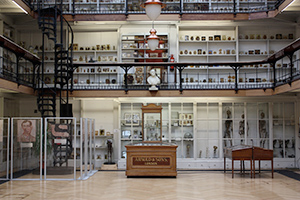
On Wed., Nov. 26th, at Barts Pathology Museum in London, Dead Meet (“Dating and Networking for Death Professionals”), is holding its Inaugural Dead Meet Up, a networking event at which noted Waugh scholar and EWS honorary vice president Ann Pasternak Slater will discuss “The Loved One.” After Ms. Pasternak Slater’s talk, Kevin Sinclair, a member of the British Institute of Embalmers, “will tell [the audience] whether or not the procedures [described] in the book are true to life.”

The event runs from 6:30 to 9:00 p.m. and is open to all, although Dead Meet members receive discounted admission and special tour privileges within Barts [sic] Pathology Museum.

Share
Posted in Discussions, Events, Lectures, The Loved One | Tagged , , , | Comments Off on Inaugural Dead Meet Up, London, Nov. 26th: “The Loved One” and the Reality of Embalming

Memoir of Lord Berners’ Menage is Published

A memoir of the residents of Lord Berners’ Faringdon House estate in Berkshire (now Oxfordshire) has been written by the granddaughter of one (or possibly two) of them. This is The Mad Boy, Lord Berners, My Grandmother and Me , by Sofka Zinovieff (Jonathan Cape, 436pp, £25, U.S. publication scheduled for 2015).

The author’s relationship to the menage is a bit complicated. Her mother, Victoria, was the child of Jennifer Fry, who lived at Faringdon in the 1940s and married Robert Heber-Percy (“The Mad Boy”). He was also Berner’s companion and may (or may not) have been Victoria’s father. Heber-Percy and Fry were soon divorced, and he later married Evelyn Waugh’s friend Dorothy (“Coote”) Lygon. Other male companions also came and went after Berners’ death in 1950. The estate was left by Berners to Heber-Percy, who kept changing his own will, causing Waugh to make the following comment in a letter to Diana Cooper dated December 12, 1950: ‘I went to dinner at Faringdon … the Mad Boy has installed a Mad Boy of his own. Has there ever been a property in history that has devolved from catamite to catamite for any length of time? It would be interesting to know.’

Heber-Percy ultimately left the estate to Zinovieff who still owns it and rents it out to American millionaires. This is all explained in more (and more entertaining) detail in a review of Zinovieff’s book by Waugh’s grandson, Alexander Waugh, in the current issue of Literary Review.

Share
Posted in Alexander Waugh, Miscellaneous | Tagged , , , | Comments Off on Memoir of Lord Berners’ Menage is Published

Last Mitford Sister Dies at 94

Deborah Cavendish (nee Freeman-Mitford), Dowager Duchess of Devonshire, died earlier this week at the age of 94.

Evelyn Waugh and she were friends, though she was not nearly as close to him as were her older sisters Nancy and Diana. They met in 1942 at a Christmas party where Waugh unfortunately made rather a fool of himself. Deborah was impressed at this first meeting with the “phenomenal amount of drink that [Waugh] consumed, and as I was still shocked by drunkenness, I kept my distance.” She also recalled that Waugh poured a bottle of Chartreuse over his head and then walked about repeatedly intoning that his hair was covered in gum. Her assessment of Waugh was that he could be charming early in the evening: “He wanted to be friends and was full of compliments, but they turned to insults before you knew where you were. The cleverness came through but so did the criticisms; everything was wrong including me.” Deborah said that after the war Waugh made up for his bad behavior by buying her a hat from Paris.

Waugh was later a guest at her house on the Chatsworth estate where he complained that a chamberpot in his room had not been emptied. In her memoir Wait for Me!, (p. 145) Deborah described Waugh as a “difficult guest” who seemed to try to find fault with everything, including “the wine, his bedroom, the outlook and, judging by his behavior, the other guests too.” The full chamberpot was his coup de grâce and was announced “with a look of triumph on his face.” Deborah said she never knew whether his claims were true but she was doubtful, because he “did not bring the evidence with him.” Waugh later wrote to Nancy Mitford in 1962 that he knew he was being a bore during his visit but had behaved badly “because she had turned on the television at dinner.”

Another anecdote from her Memoirs recounted a gift that Waugh had sent her. Waugh, knowing that Deborah was not a great reader, sent her a copy of his biography of Roman Catholic cleric Ronald Knox, assuring her in his inscription that her Protestant sensibilities would not be offended. After unwrapping the parcel and feeling rather pleased with herself, she found that the pages of the book were all blank.

In her later years, Deborah also tried her hand at writing, but her output was never going to rival the works of her older sisters, Nancy, Diana and Jessica, who made successful careers as authors. In addition to publishing her memoirs in 2010, Deborah wrote about her experiences at Chatsworth which she managed to turn from a losing operation into a successful business venture by marketing its farm produce and promoting it as a major tourist attraction.

Her sisters predeceased her, as did her brother, Tom, who was killed in World War II.
Share
Posted in Letters, Miscellaneous, Ronald Knox | Tagged , , | Comments Off on Last Mitford Sister Dies at 94

Daily Mail Reports Sale of Waugh’s Favorite Writing Venue

The Daily Mail online edition for 16 September reports the offer for sale of the Easton Court Hotel in Chagford, Devon. This is the place to which Evelyn Waugh retreated to do much of his writing, including that for his most popular work, Brideshead Revisited. It provided him the peace and quiet he needed away from the distractions of his family and friends.

As reported in the story by Jenny Awford, the hotel has preserved the modest library in which Waugh worked. It looks much as it did about 20 years ago when your correspondent spent a night there. Other writers who used the hotel include Patrick Leigh-Fermor, with whom Waugh overlapped on at least one occasion in 1956. They invited their mutual friend and correspondent Ann Fleming to join them, but she declined (perhaps fearing that she would be interrupting the seclusion they needed to write). Waugh also formed a friendship with the then co-owners. When one of them, Caroline Postlethwaite-Cobb, died in the late 1950s, Leigh-Fermor reported that he, along with Waugh and his wife Laura, were among the few mourners present at her funeral service in the village.

The photos accompanying the Daily Mail article suggest that the place has been well preserved. It is on offer for £1.65 million. Thanks to Robert Murray Davis for bringing this to our attention.

Share
Posted in Locations | Tagged , , | Comments Off on Daily Mail Reports Sale of Waugh’s Favorite Writing Venue